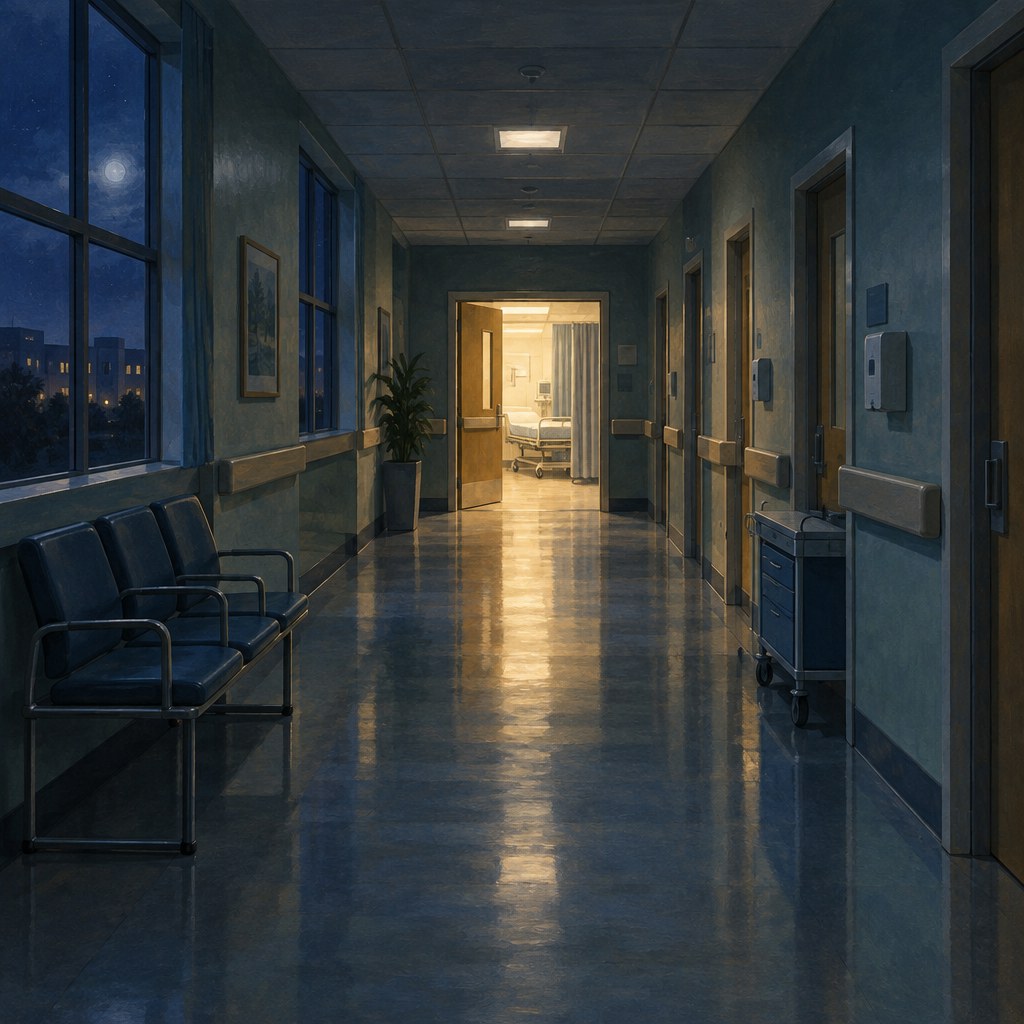
A personal story by Soulsearcher. The featured image is an illustration, not a photograph of the events.
During COVID, my regular infusions had to be done at home.
Going into hospital carried its own risks. Hospitals were overwhelmed, wards were under quarantine, and because of my health problems, avoiding unnecessary exposure seemed the safest option.
A registered nurse would come to my home, administer my infusion and, because I was at home, I could continue working at the same time.
On this particular day, everything started normally.
The infusion finished, the nurse stayed for a while and then left. I went back to work.
It was probably around five in the afternoon when something began to feel wrong.
My muscles started cramping.
First my legs and arms. Then breathing became difficult.
At that stage, nobody knew that I had a serious problem maintaining my potassium levels. We would later discover extremely high aldosterone levels and learn that my body was losing far more potassium than it should.
I would see specialists. I would undergo investigations and genetic testing.
But ultimately there would be no simple explanation for why my body did this.
That evening, however, I knew none of that.
I only knew that my body was shutting down.
Eventually I was on the floor.
I couldn’t use my muscles properly. I couldn’t stand. Even my tongue would not cooperate when I tried to speak.
All I could do was lie there and concentrate on breathing.
Breathe in.
Breathe out.
Keep breathing.
My father eventually came to check on me.
At that time, my mother had not yet been diagnosed with Alzheimer’s. She and my father somehow managed to get me up, carry me to the car and rush me to the nearest emergency department.
I was assessed immediately.
The doctor on duty called a cardiologist. He looked at my ECG and vital signs and told the other doctor that there appeared to be a blockage.
He said he needed to operate.
I was lying on the bed, barely able to move or speak, with nurses around me.
And something inside me became absolutely clear.
No.
I cannot explain it better than that.
I knew I had to leave.
I knew I needed to get to the hospital where I was normally treated.
There was no careful reasoning behind it. I wasn’t in a condition to analyse medical information or weigh up alternatives.
It was simply an extraordinary certainty.
I could not stay there.
The medical staff did not want me to leave because I was unstable.
I fought them.
I swore.
With enormous difficulty, I managed to make it clear that I was refusing treatment there and wanted to be transferred.
I signed a waiver.
I remember thinking that I would rather take the risk of dying on the way to the other hospital than allow them to operate on me.
Looking back, that sounds extreme.
But in that moment, I had no doubt.
Something was telling me to go.
When I arrived at the other hospital, another cardiologist looked at my ECG.
His response was immediate.
Potassium.
I was given potassium intravenously and more potassium to drink in orange juice. Blood was taken.
The treatment continued, followed by more blood tests and another ECG.
Eventually, my ECG returned to normal.
There was no blockage.
My heart had been struggling because my potassium level was dangerously low.
My potassium level was 2.2 — dangerously low and well below the normal range.
I later underwent further testing to determine whether I had suffered a heart attack. I hadn’t.
A scan of my heart revealed something else I hadn’t known. I was told my heart was smaller than average, but the measurement they used for the strength of my heart was 7.5, when I was told the upper end of the normal range was 5. The cardiologist explained that the strength of my heart muscle had helped me survive what had happened.
I had survived.
Later came the search for an explanation.
Specialists. Tests. Genetic investigations. Questions about aldosterone and why my body was losing so much potassium.
Some answers came.
Others never did.
But there is another question from that night that medicine cannot really answer for me.
Why was I so certain that I had to leave?
I had no medical knowledge telling me that the diagnosis was wrong.
I could barely move.
I could barely speak.
I had just been told that there was a blockage in my heart and that I needed an operation.
Logically, that should have been the moment when I surrendered control and allowed the doctors to do whatever they believed was necessary.
Instead, something in me said:
Go.
And I listened.
I don’t know whether it was instinct, intuition, fear, some subconscious awareness—or simply one of those decisions we make in extreme circumstances that we only understand afterwards.
I don’t want to pretend that I know.
What I do know is that I left.
At the second hospital, they found the problem.
And that night, once again, my life continued.
— Soulsearcher
Editorial note: personal experience and emergency care
This is Soulsearcher’s recollection of a medical emergency, including test measurements as remembered. It has not been verified against medical records and should not be used to interpret someone else’s results. Severe low potassium can cause dangerous heart rhythms and needs medical treatment; do not try to correct it yourself. If care concerns arise during an emergency, request a senior review and a medically arranged transfer where needed rather than leaving without safe support. See MedlinePlus on low potassium.
Leave a Reply