Category: Soulsearcher

  • Know Your Worth — And Stop Chasing People Who Don’t

    Know Your Worth — And Stop Chasing People Who Don’t

    A personal reflection on relationships and self-respect. Featured artwork is illustrative.

    There comes a point in life when you realise something important: Not everyone deserves unlimited access to you.

    You can care deeply about people. You can love them, support them, forgive them, and still reach a point where you have to stop chasing them.

    Stop chasing people who only remember you when they need something.

    Stop begging for the bare minimum.

    Stop trying to convince people to see your value.

    Stop exhausting yourself trying to hold together relationships that only survive because you keep doing all the work.

    Know Your Worth

    Your value does not decrease because someone fails to recognise it.

    You should not have to constantly prove that you are worthy of respect, honesty, effort, loyalty, or love. The people who genuinely value you will not repeatedly make you question where you stand with them.

    Sometimes we stay too long because we remember who someone used to be. We remember the good moments. We remember what we hoped the relationship could become. And we keep giving chances because walking away feels like giving up.

    But there is a difference between giving up on someone and finally choosing yourself.

    Pay Attention to Actions

    People can say anything. Actions tell you where you truly stand.

    If someone continually ignores you, dismisses you, disrespects you, or only appears when it suits them, believe the pattern.

    You do not need to become angry. You do not need revenge. You do not need to prove a point.

    You can simply step back.

    Sometimes the strongest thing you can do is stop forcing a connection and allow people to show you how much effort they are willing to make when you are no longer carrying the entire relationship.

    Stop Chasing

    If someone wants to be part of your life, there should be effort from both sides.

    Relationships should not feel like one person constantly reaching out while the other decides when it is convenient to respond. Friendship, family, love and human connection all require reciprocity.

    You deserve people who check on you too.

    People who make time for you.

    People who respect your boundaries.

    People who do not make you feel difficult for having feelings.

    People who value your presence rather than only noticing your absence.

    Walking Away Can Be an Act of Self-Respect

    Walking away does not always mean you stopped caring.

    Sometimes it means you finally understood that caring about someone should not require abandoning yourself.

    You can wish people well from a distance. You can forgive without reopening the door. You can remember the good without returning to what hurt you.

    And you can choose peace without feeling guilty for it.

    Choose the People Who Choose You

    Life is too short to spend it chasing people who repeatedly show you that they do not value your presence.

    Give your time to the people who show up.

    Give your energy to the people who give energy back.

    Give your love to the people who treat it with care.

    And above all, remember your own worth.

    Stronger Together begins with recognising the value in others—but never forgetting the value within ourselves.

  • I Knew I Had to Leave

    I Knew I Had to Leave

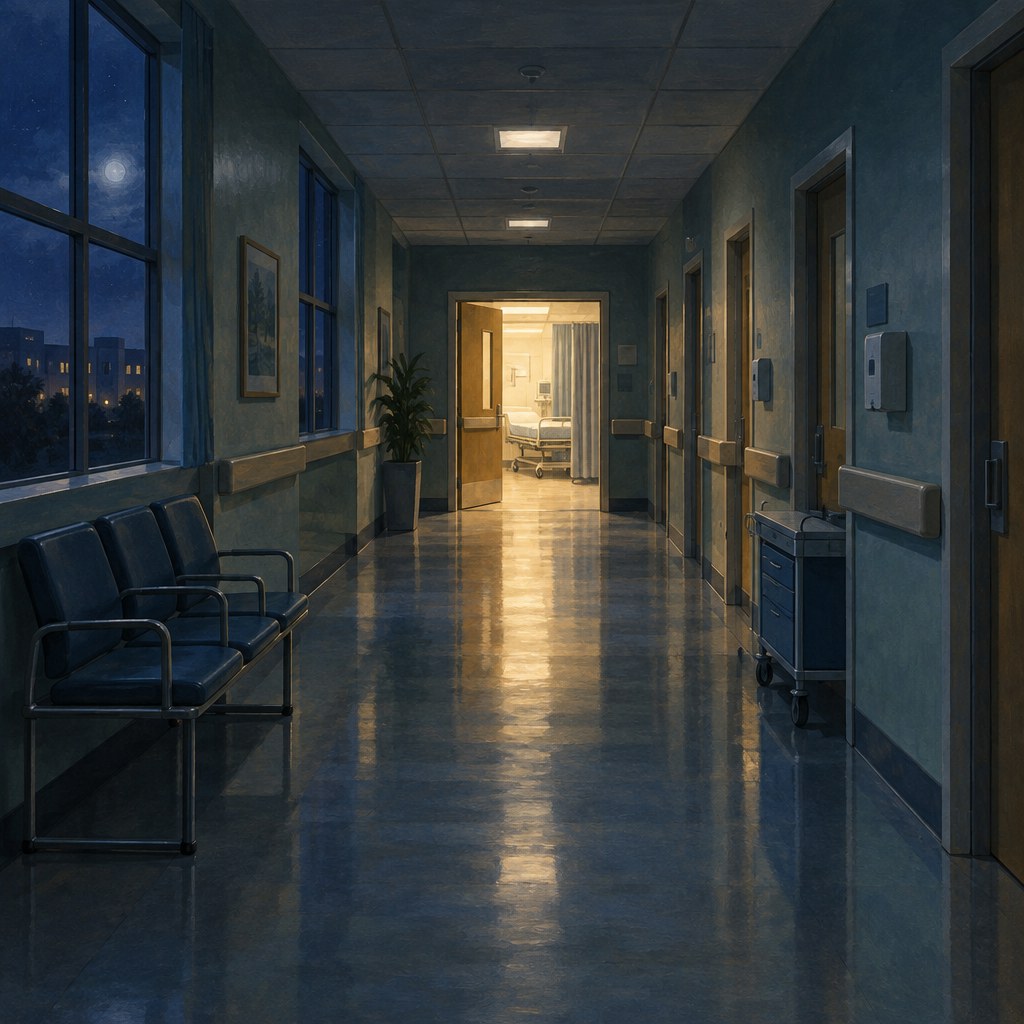
    A personal story by Soulsearcher. The featured image is an illustration, not a photograph of the events.

    During COVID, my regular infusions had to be done at home.

    Going into hospital carried its own risks. Hospitals were overwhelmed, wards were under quarantine, and because of my health problems, avoiding unnecessary exposure seemed the safest option.

    A registered nurse would come to my home, administer my infusion and, because I was at home, I could continue working at the same time.

    On this particular day, everything started normally.

    The infusion finished, the nurse stayed for a while and then left. I went back to work.

    It was probably around five in the afternoon when something began to feel wrong.

    My muscles started cramping.

    First my legs and arms. Then breathing became difficult.

    At that stage, nobody knew that I had a serious problem maintaining my potassium levels. We would later discover extremely high aldosterone levels and learn that my body was losing far more potassium than it should.

    I would see specialists. I would undergo investigations and genetic testing.

    But ultimately there would be no simple explanation for why my body did this.

    That evening, however, I knew none of that.

    I only knew that my body was shutting down.

    Eventually I was on the floor.

    I couldn’t use my muscles properly. I couldn’t stand. Even my tongue would not cooperate when I tried to speak.

    All I could do was lie there and concentrate on breathing.

    Breathe in.
    Breathe out.
    Keep breathing.

    My father eventually came to check on me.

    At that time, my mother had not yet been diagnosed with Alzheimer’s. She and my father somehow managed to get me up, carry me to the car and rush me to the nearest emergency department.

    I was assessed immediately.

    The doctor on duty called a cardiologist. He looked at my ECG and vital signs and told the other doctor that there appeared to be a blockage.

    He said he needed to operate.

    I was lying on the bed, barely able to move or speak, with nurses around me.

    And something inside me became absolutely clear.

    No.

    I cannot explain it better than that.

    I knew I had to leave.

    I knew I needed to get to the hospital where I was normally treated.

    There was no careful reasoning behind it. I wasn’t in a condition to analyse medical information or weigh up alternatives.

    It was simply an extraordinary certainty.

    I could not stay there.

    The medical staff did not want me to leave because I was unstable.

    I fought them.

    I swore.

    With enormous difficulty, I managed to make it clear that I was refusing treatment there and wanted to be transferred.

    I signed a waiver.

    I remember thinking that I would rather take the risk of dying on the way to the other hospital than allow them to operate on me.

    Looking back, that sounds extreme.

    But in that moment, I had no doubt.

    Something was telling me to go.

    When I arrived at the other hospital, another cardiologist looked at my ECG.

    His response was immediate.

    Potassium.

    I was given potassium intravenously and more potassium to drink in orange juice. Blood was taken.

    The treatment continued, followed by more blood tests and another ECG.

    Eventually, my ECG returned to normal.

    There was no blockage.

    My heart had been struggling because my potassium level was dangerously low.

    My potassium level was 2.2 — dangerously low and well below the normal range.

    I later underwent further testing to determine whether I had suffered a heart attack. I hadn’t.

    A scan of my heart revealed something else I hadn’t known. I was told my heart was smaller than average, but the measurement they used for the strength of my heart was 7.5, when I was told the upper end of the normal range was 5. The cardiologist explained that the strength of my heart muscle had helped me survive what had happened.

    I had survived.

    Later came the search for an explanation.

    Specialists. Tests. Genetic investigations. Questions about aldosterone and why my body was losing so much potassium.

    Some answers came.

    Others never did.

    But there is another question from that night that medicine cannot really answer for me.

    Why was I so certain that I had to leave?

    I had no medical knowledge telling me that the diagnosis was wrong.

    I could barely move.

    I could barely speak.

    I had just been told that there was a blockage in my heart and that I needed an operation.

    Logically, that should have been the moment when I surrendered control and allowed the doctors to do whatever they believed was necessary.

    Instead, something in me said:

    Go.

    And I listened.

    I don’t know whether it was instinct, intuition, fear, some subconscious awareness—or simply one of those decisions we make in extreme circumstances that we only understand afterwards.

    I don’t want to pretend that I know.

    What I do know is that I left.

    At the second hospital, they found the problem.

    And that night, once again, my life continued.

    — Soulsearcher

    Editorial note: personal experience and emergency care

    This is Soulsearcher’s recollection of a medical emergency, including test measurements as remembered. It has not been verified against medical records and should not be used to interpret someone else’s results. Severe low potassium can cause dangerous heart rhythms and needs medical treatment; do not try to correct it yourself. If care concerns arise during an emergency, request a senior review and a medically arranged transfer where needed rather than leaving without safe support. See MedlinePlus on low potassium.

  • The White Birds

    The White Birds

    A personal story by Soulsearcher. The featured image is an illustration, not a photograph of the events.

    It was just another day after work.

    At about six in the evening, I was driving to fetch a friend from work. It was summer, so it was still light, and there was almost no traffic on the road.

    I approached an intersection and drove through a green light.

    Then I looked to my left.

    A truck was speeding directly towards me.

    It wasn’t stopping at the red light.

    There was no time to think.

    The truck appeared to be travelling at around 120 kilometres per hour. I was doing approximately 35.

    All I could do was take my foot off the accelerator and turn the steering wheel to the right.

    Then came the impact.

    After that, there is nothing.

    I was unconscious and have no memory of what happened immediately afterwards.

    The next thing I remember is people trying to get me out of my car.

    It was smoking.

    They had to pry the door open.

    Three airbags had deployed, and fortunately I was sitting in a bucket seat.

    My car had travelled roughly 100 metres from the point of impact and ended up wrapped around a pole.

    When I regained consciousness, I suddenly felt terrible pain in my left shoulder and neck.

    And then, strangely, very little.

    Apart from seat-belt burns and an injury to my hand, I seemed remarkably intact.

    My left hand had become trapped between the steering wheel and the shattered windscreen at the twelve o’clock position.

    I was extremely dizzy.

    I later learned that the truck had continued after hitting me. It took out two lamp posts on the other side of the road, struck and wrote off a Toyota Land Cruiser bakkie parked near a petrol station further down the road, and eventually came to a stop near the petrol pumps.

    Looking at what had happened, it was difficult to understand how I had walked away.

    Maybe it was the concussion.

    Maybe it was shock.

    But I remember feeling strangely calm.

    I reached through the crushed metal around the roof and left side of the car and managed to retrieve my keys and purse.

    Then I got out.

    That was when the dizziness really hit me.

    I sat down on the pavement.

    And I looked at my car.

    It was destroyed.

    Completely crushed—except for the area around my bucket seat.

    Blood was dripping from my hand.

    And then something happened that I have never forgotten.

    Across the road was a beautiful tree.

    I found myself looking at it.

    Suddenly, around a hundred white birds flew out of the tree.

    They were unlike any birds I remembered seeing before.

    They rose together, circled, and then returned to the tree.

    I watched them.

    Then they did it again.

    They flew from the tree, circled, and returned.

    And then a third time.

    The birds rose together, made another circle and landed back in the tree.

    After the third time, they flew away.

    I just sat there watching them.

    For a moment, everything else seemed to disappear.

    The destroyed car.

    The blood.

    The people.

    The noise.

    The fact that only moments earlier I had been hit by a truck travelling at enormous speed.

    There were just these white birds.

    A woman who had witnessed the accident came and sat beside me.

    I turned to her and asked:

    “Did you see that?”

    She said yes.

    Then she told me something that has always mattered to me when I remember that moment.

    She had never seen anything like it either.

    So I know the birds weren’t something I imagined while concussed.

    Someone else saw them too.

    I don’t know what kind of birds they were.

    I don’t know why so many of them were sitting in that particular tree.

    I don’t know why they took off, circled and returned three times before finally disappearing.

    There may be a completely ordinary explanation.

    But sitting on that pavement beside the wreckage of my car, bleeding and dizzy, having somehow survived an accident that could very easily have ended differently, it did not feel like an ordinary moment.

    It felt incredibly still.

    Almost as though, for those few minutes, everything had slowed down.

    I have never forgotten those birds.

    Just as I have never forgotten the blue-white light from another experience in my life.

    And just as, years later, I would never forget the woman who appeared beside my hospital bed wearing a large owl pendant.

    Three completely different experiences.

    A light.

    White birds.

    An owl.

    And there is something else they share.

    They appeared at moments surrounded by chaos.

    And somehow, in each of those moments, there was peace.

    I don’t know what that means.

    Perhaps one day I will.

    Perhaps I never will.

    But I know what I saw.

    And this time, someone else saw it too.

    — Soulsearcher

  • The Woman With the Owl Pendant

    The Woman With the Owl Pendant

    A personal story by Soulsearcher. The featured image is an illustration, not a photograph of the events.

    Another day in hospital.

    I had been admitted to a private hospital for an infusion and potassium drip. I had been going to the same hospital, and even the same ward, for more than thirteen years.

    But this time was different.

    It became one of the worst hospital experiences I have ever had.

    There were problems with the pharmacy. The ward appeared desperately understaffed. Nobody offered me water or food, and I repeatedly had to ring the alarm when my drip bottles needed changing.

    Sometimes nobody came in time.

    The fluid would run out and air would enter the line because no one had arrived to change the bottle.

    Eventually, I had enough.

    I pulled out my drip and walked to the administration kiosk myself.

    This was supposed to be a high-care unit.

    I lost my temper.

    I complained to everyone who would listen and eventually spoke to both the ward manager and administration. It wasn’t the first time I had raised concerns there.

    What frustrated me even more was being told that beds were unavailable or that parts of the hospital were undergoing maintenance, while I would often find myself in a room surrounded by three empty beds.

    After I made enough noise, things improved somewhat.

    Eventually, they moved me into a private room in another ward, where the care was considerably better.

    I thought that would be the part of this hospital stay I remembered.

    It wasn’t.

    Something else happened.

    For two mornings, a woman came to see me.

    She wasn’t dressed like hospital staff. She wore casual, almost hippie-style clothing and had a warm smile.

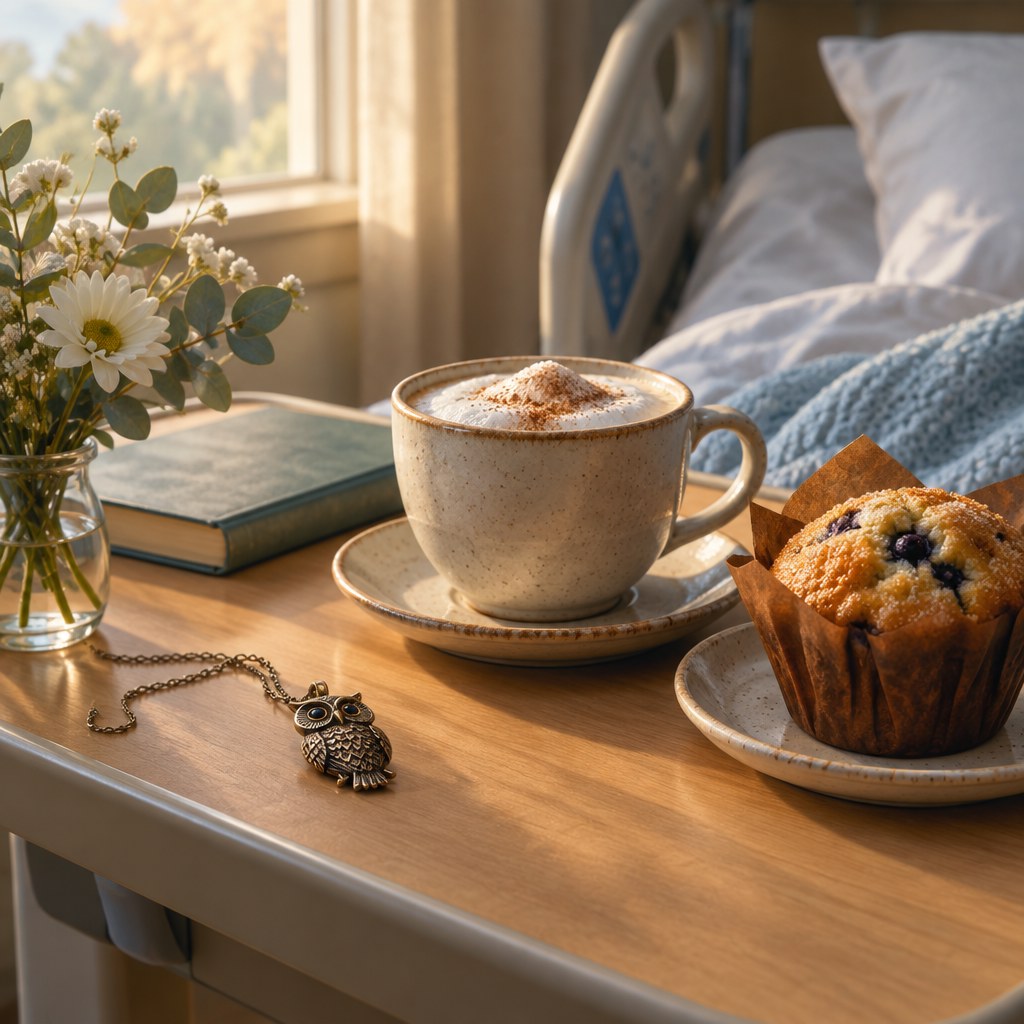
    Each morning, she brought me a cappuccino and a muffin.

    Then she sat with me.

    She didn’t ask what was wrong with me.

    She didn’t ask about my treatment.

    She didn’t seem to want anything.

    She simply sat there and talked.

    She told me about her son and mentioned that she lived just down the road. We spoke for a while, almost as though we were two people sitting in a coffee shop rather than inside a hospital.

    There were two things about her that I have never forgotten.

    The first was her answer when I finally asked the obvious question.

    Who are you?

    Why are you bringing me food?

    Why are you here?

    She never gave me her name.

    She never told me her position.

    She simply said:

    “That’s what I do.”

    The second thing was the pendant around her neck.

    It was a large owl.

    Not something subtle that I might have imagined or remembered incorrectly. It was impossible not to notice.

    At one point, the paper dispenser beside my bed wasn’t working.

    She made a phone call.

    Within five minutes, someone arrived and fixed it.

    That made things even stranger.

    Clearly, she had some connection to the hospital.

    But when I asked members of staff who she was, nobody seemed to know.

    And then she was gone.

    To this day, I still don’t know her name.

    I don’t know whether she worked for the hospital, volunteered there, knew somebody in management, or was simply an unusually compassionate person who had somehow found her way into my room.

    Perhaps there is a perfectly ordinary explanation.

    But I have never forgotten what she did.

    In the middle of an experience filled with frustration, anger and chaos, this stranger walked into my room carrying a cappuccino and a muffin.

    She didn’t try to solve my problems.

    She didn’t ask me to explain myself.

    She simply sat with me.

    And somehow, she brought peace into the room.

    Maybe that is the part that has stayed with me.

    We often think helping someone requires doing something enormous.

    Perhaps sometimes it doesn’t.

    Sometimes it is noticing the person everyone else is too busy to notice.

    Sometimes it is sitting beside someone without asking them to justify why they are struggling.

    Sometimes it is a cup of coffee, a muffin and a conversation.

    And sometimes a complete stranger can walk into one of the most chaotic moments of your life, leave without even telling you her name, and remain in your memory for years.

    I still don’t know who the woman with the owl pendant was.

    Maybe I never will.

    But perhaps knowing her name was never the important part.

    What mattered was that she came.

    — Soulsearcher

    Editorial note: speaking up about care

    This is a personal recollection, not an instruction to remove an infusion or leave treatment. If an infusion or your care seems unsafe, call the nurse and request an urgent senior review. Ask for the ward manager or patient liaison service if concerns remain unresolved.

  • The Place Beyond the Storm

    The Place Beyond the Storm

    A personal story by Soulsearcher. The featured image is an illustration, not a photograph of the events.

    I have had many dreams connected to water—often floods, and the urgency of reaching or building a boat before the water came. Strangely, those dreams occurred before earthquakes, floods and tsunamis began dominating the news.

    But one dream was different.

    It has never left me.

    It began with my brother and a few friends asking me to meet them somewhere. That alone was unusual, as my brother and I rarely speak or see each other.

    I went, but nobody arrived.

    Instead, I found myself beside the sea. Two people were there, allowing people to crawl out over the water on what looked like a floating wooden ladder.

    The weather was violent. Rain poured down, gale-force winds battered the sea, and boats were breaking loose from their moorings.

    Yet I wasn’t cold.

    I wasn’t wet.

    And I wasn’t afraid.

    I climbed onto the ladder and made my way across the sea until I reached the end.

    Then I looked down.

    Beneath me was a beautiful blue-white light.

    I couldn’t take my eyes off it.

    My gaze seemed fixed to it. I couldn’t look away—and I didn’t want to.

    The storm continued around me, but suddenly none of it mattered.

    There was only the light.

    And with it came something I still struggle to describe:

    complete peace.

    I felt completely safe. There was no fear, no urgency, no sense of danger. I wanted to remain there forever.

    Eventually, I managed to look up.

    A boat that had broken free was drifting towards me, and somehow I knew I had to leave.

    I felt deeply sad and reluctant to turn away from the light, but I knew I had to return.

    I made my way back to shore.

    The moment I reached land, the wooden ladder broke apart completely.

    The two people weren’t concerned. They simply said, “Don’t worry. We’ll put another one up.”

    Then I woke.

    But the experience didn’t end there.

    I woke still feeling that same extraordinary peace. When I closed my eyes, I could still see the blue-white light.

    Even now, remembering it can bring back something of that calm.

    I have often wondered what happened that night.

    Was the storm a representation of life’s chaos? Was the light something buried deep within my subconscious—a place of absolute safety that my waking mind could never normally reach?

    Perhaps our subconscious is far more powerful than we could ever imagine.

    But there is another possibility I cannot completely dismiss.

    What if there was something else there too?

    I cannot say the experience was spiritual, just as I cannot say it was only a dream. I simply don’t know.

    What I do know is that I travelled into a storm without fear, found a blue-white light I could barely tear my eyes away from, and experienced a peace so profound that I did not want to leave it.

    But I did.

    And somehow, I brought some of that peace back with me.

    Perhaps there is more within us than we understand.

    And perhaps there is more beyond us, too.

    — Soulsearcher

  • I Realised This Morning That I Lost My Mom Two Years Ago

    I Realised This Morning That I Lost My Mom Two Years Ago

    I realised this morning that I lost my mom two years ago

    I woke up this morning and started crying.

    It wasn’t the usual sadness. Not the tears I have cried on my way to work, or on the way home, trying to pull myself together before walking through the door again.

    These were different.

    These were tears of mourning.

    Because this morning, I realised something I think part of me has known for a long time:

    I lost my mom two years ago.

    The person I am caring for is still here physically, but the woman I knew as my mother is disappearing beneath the illness.

    The anger. The aggression. The cruelty. The shouting. The behaviour that can make me feel more like a servant than a daughter.

    That is not the mother I remember.

    It can’t be.

    My mother had faults. Of course she did. We all do. But she was a good person.

    She was the kind of person who would go out of her way to help somebody else. She never swore. She gave me everything I could have wanted as a child, but somehow managed to do it without spoiling me.

    And there is one sentence she said throughout my life that I will probably carry with me forever:

    “There are things in life you don’t want to do, but you have to.”

    I understand those words differently now.

    Grieving Someone Who Is Still Here

    Caring for someone you love can ask things of you that you never imagined you would have to do. It can strip away sleep, freedom, patience, certainty and sometimes even the relationship you once had with that person.

    And perhaps one of the cruellest parts is that nobody tells you when you are allowed to grieve.

    There is no funeral.

    No clear goodbye.

    The person is sitting in front of you, and yet you can still miss them desperately.

    You can love the person they were, care for the person they have become, feel hurt by their behaviour, feel angry, exhausted and heartbroken — all at the same time.

    This morning I finally understood that I am not only caring for my mother.

    I am mourning her too.

    And maybe that is something we need to talk about more.

    Trying to Understand What Dementia Changes

    And then another thought came to me.

    What if, underneath everything, we are more like machines than we want to admit?

    What if the part of the brain that holds our memories, our judgement, our restraint, our sense of who we are begins to fail — and what is left is simply reaction?

    For a moment I wondered whether that is what I am seeing now. Not my mother as I knew her, but a body still functioning after so much of the person inside has been stripped away.

    But then I asked myself: if that is true, where does all the anger come from? Where does the violence come from?

    I know the medical explanation. I know dementia damages the brain. I know areas responsible for judgement, inhibition, memory and emotional control can stop working as they once did.

    Maybe that is part of the answer.

    Maybe when all the layers that taught us how to contain fear, frustration and confusion begin to disappear, the most basic reactions are the ones left exposed.

    I don’t know.

    Separating the Illness From the Person

    But I do know this: when she is angry with me, I have to keep reminding myself that the illness is speaking through a brain that no longer works the way hers once did.

    That does not make being shouted at, threatened or hurt easy.

    It does not mean a carer should simply accept abuse.

    But sometimes understanding where it may be coming from is the only thing that helps me separate the illness from the mother I remember.

    I don’t have all the answers. I’m living this as I write it.

    But if you are caring for someone who is slowly disappearing in front of you, perhaps you recognise some of these feelings.

    The anger. The guilt. The exhaustion. The grief for somebody who is still sitting beside you.

    If you do, I want you to know that there is a place here where we can talk about the things people don’t always know how to say.

    Because sometimes being stronger together simply begins with knowing that somebody else understands.

    — Soulsearcher

    If This Feels Familiar, You Do Not Have to Carry It Alone

    Choose the next step that feels most useful to you.

    Editorial note: changes in dementia and caregiver safety

    This account expresses one caregiver’s grief. People with dementia retain dignity and may experience needs they cannot easily communicate. Sudden changes in behaviour deserve medical assessment: pain, infection, medicines or other problems can contribute. See the Alzheimer’s Association guidance on behaviour changes. If anyone is at immediate risk, seek emergency help and move to safety if possible.